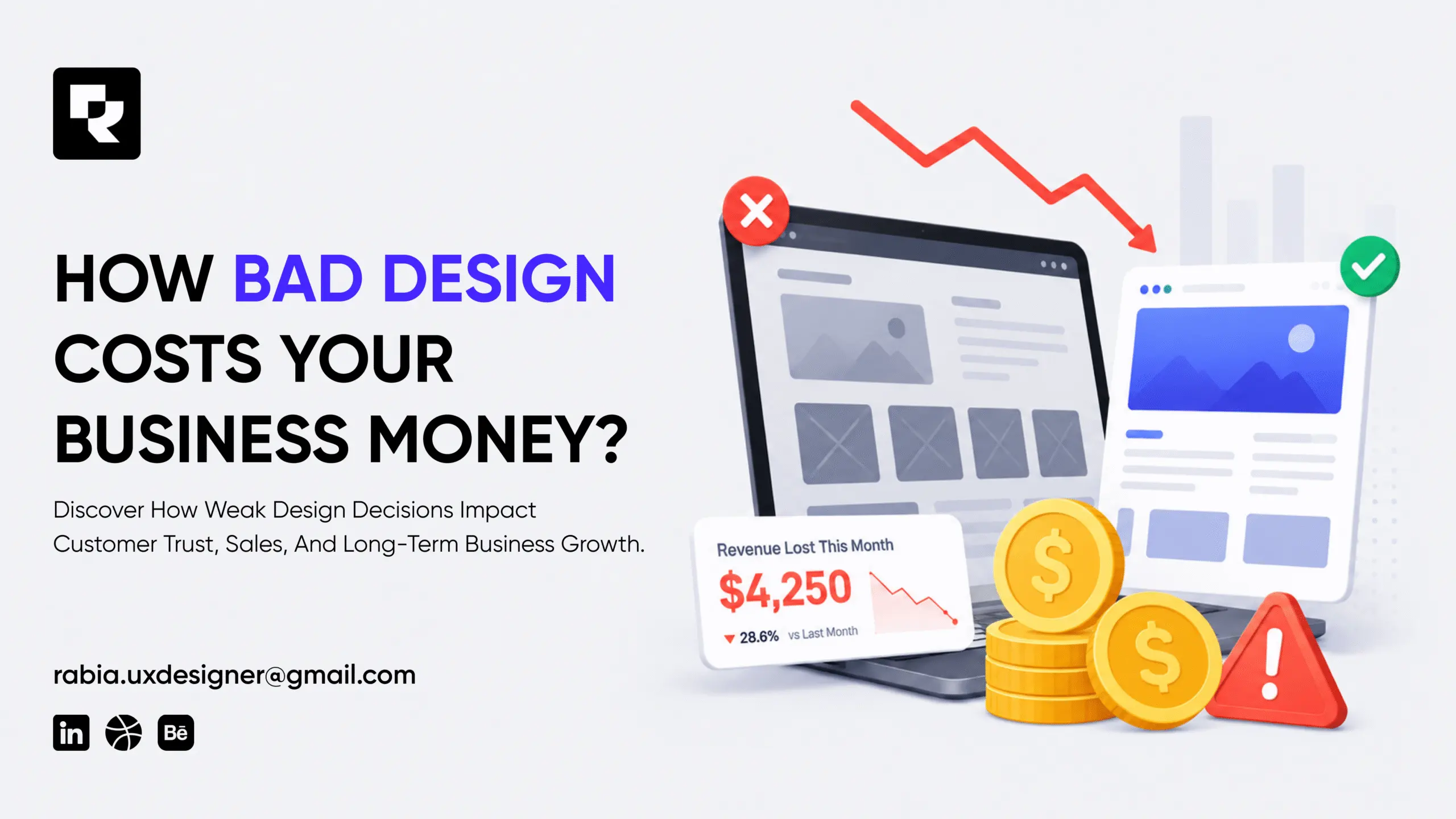
Your Design Isn’t “Just Bad.” It’s Expensive.
You’ve probably heard “design is subjective” a hundred times. Here’s the uncomfortable truth: subjective or not, ugly design has a very objective price tag and it’s being deducted from your revenue every single day, whether you notice it or not.
Most business owners think of design as a cosmetic expense. 5 logo mistakes could be silently killing your sales. A logo. A color palette. Something you fix “when there’s budget.” But design isn’t decoration it’s the first impression, the trust signal, and often the deciding factor between a visitor who buys and one who bounces.
Below, we’ll break down exactly where that cost hides, how to calculate your own losses, and what to do about it backed by real industry data and years of hands-on design consulting experience.
The Real Cost of Bad Design: Where the Money Leaks
1. Lost First Impressions (You Only Get One)
Research on user behavior consistently shows that people form an opinion about a website within a fraction of a second within milliseconds of landing on it. That opinion professional or amateur, trustworthy or sketchy shapes whether they stay, scroll, or leave immediately.
If your site looks outdated, cluttered, or inconsistent, visitors don’t consciously think “bad design.” They think “I don’t trust this business” and click back to Google. And your website could be driving customers away. That’s a lost customer before you even had a chance to make your pitch.
2. Higher Bounce Rates, Lower Conversions
A confusing layout, inconsistent branding, or a logo that doesn’t communicate professionalism increases your bounce rate. Every visitor who leaves without acting represents:
- Wasted ad spend (if they came from a paid campaign)
- Wasted SEO effort (if they came from organic search)
- A missed sale that likely went to a competitor with a cleaner, more trustworthy design
3. Weaker Brand Recall
Inconsistent fonts, colors, and messaging across your website, social media, and marketing materials make your brand forgettable. a stunning brand identity can skyrocket your business. Strong, consistent branding builds recognition and recognition builds trust over repeated exposure. Without it, you’re starting from zero with every single interaction.
4. Lower Perceived Value (Even If Your Product Is Great)
People associate visual quality with product/service quality. A cheap-looking website or logo signals “this might be a cheap or unreliable business” even if your offering is exceptional. This perception gap directly affects what customers are willing to pay you.
5. Increased Customer Acquisition Cost (CAC)
When your design isn’t converting, you need more traffic to get the same number of sales. That means higher ad spend, higher CAC, and thinner margins all traceable back to a design problem, not a marketing problem.
💰 Calculate Your Own “Ugly Design” Losses
Here’s a simple formula you can run right now to estimate your own losses:
Step 1: Monthly website visitors × Your current conversion rate = Current customers
Step 2: Monthly website visitors × Industry average conversion rate for well-designed sites in your niche = Potential customers
Step 3: (Potential customers − Current customers) × Your average order value = Your monthly loss from design gaps
Example:
- 5,000 monthly visitors
- Current conversion rate: 1% → 50 customers
- Industry benchmark for strong design: 2.5% → 125 customers
- Average order value: $150
- Monthly loss: 75 missed customers × $150 = $11,250
- Annual loss: $135,000
Even a modest design gap compounds fast. This is why “we’ll fix the website later” is one of the most expensive sentences in business.
Signs Your Design Is Quietly Costing You Money
- Visitors land on your site and leave in under 10 seconds
- Your bounce rate is significantly higher than industry average
- People say your business “looks unprofessional” or ask if you’re a real company
- Your competitors with weaker products are outselling you
- Your branding looks different across your website, Instagram, and business cards
- You’re spending more on ads but conversions aren’t improving
If two or more of these sound familiar, design is likely part of your revenue problem not just an aesthetic one.
How to Stop the Bleeding: A Practical Fix Plan
- Audit your current design against your conversion goals. Identify exactly where visitors drop off.
- Standardize your branding across every touchpoint, website, social, print, email.
- Simplify your website’s user journey. Fewer clicks to purchase = fewer chances to lose someone.
- Invest in professional design as infrastructure, not decoration. Treat it the way you’d treat your website hosting or your sales team as something that directly impacts revenue.
- Track before-and-after metrics. Conversion rate, bounce rate, and average order value should all move after a proper design fix measure it.
Why This Matters More in 2026
With AI-driven search and AI shopping assistants now influencing more buying decisions, trust signals matters as UI/UX design trends continue to evolve. AI tools evaluating “which business to recommend” often weigh clarity, professionalism, and consistency the same signals human visitors respond to. Ugly, confusing design doesn’t just cost you human customers anymore; it can cost you visibility in AI-powered recommendations too.
Frequently Asked Questions
How much does bad design really cost a small business?
It varies by industry and traffic volume, but even a 1-2% conversion rate gap can translate into tens of thousands of dollars in lost annual revenue for a business with moderate website traffic.
What’s the fastest way to know if my design is hurting sales?
Compare your website’s conversion rate to your industry’s average. If you’re significantly below benchmark, design is likely a contributing factor along with page speed and messaging clarity.
Is redesigning a website worth the investment?
For most businesses, yes. A well-executed redesign typically pays for itself through improved conversion rates within a few months, especially when paired with clear calls-to-action and consistent branding.
How often should a business update its design?
Most brands benefit from a design review every 2-3 years, or sooner if conversion metrics are declining, the brand has evolved, or the current design no longer reflects the business accurately.
Yes. Poor design often correlates with high bounce rates and low dwell time both signals search engines use to evaluate content quality and relevance.
Ready to Find Out What Your Design Is Really Costing You?
You don’t have to guess. A professional design audit can show you exactly where you’re losing customers and what it would take to fix it.
👉 Get a Free Design & Revenue Audit